St. Brigid’s Cross at Home: A Tradition of Rushes and Welcome
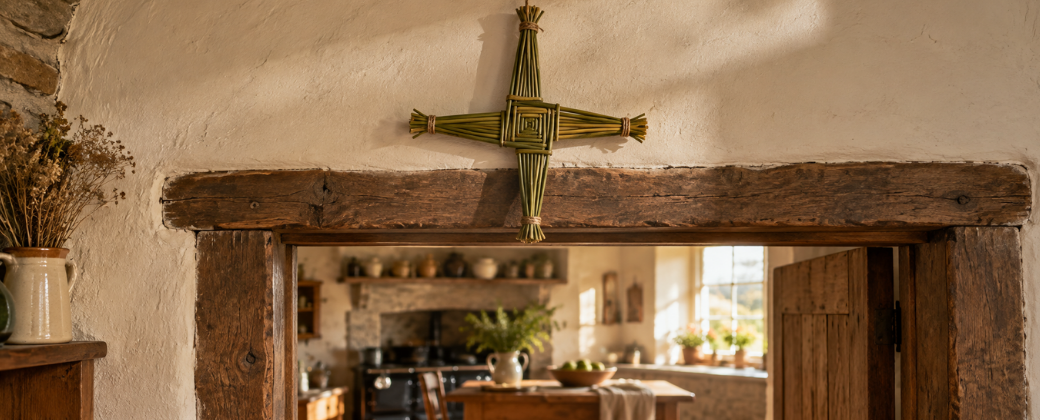
There is something beautiful about a tradition that begins with a handful of rushes.
For generations, families across Ireland have gathered to weave St. Brigid’s crosses — simple, meaningful objects traditionally placed in homes as signs of blessing and protection.
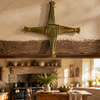
A cross above the doorway. A welcoming home. A custom passed from one pair of hands to another.
The St. Brigid’s cross tradition is more than a craft. It is part of Ireland’s living heritage, connecting faith, folklore, family and the changing seasons.
Whether you grew up making these crosses or are discovering the custom for the first time, you can bring this piece of Irish tradition into your own home.
What is a St. Brigid’s Cross?
A St. Brigid’s Cross is a woven cross traditionally made from rushes, straw or reeds. It takes its name from Saint Brigid of Kildare, one of Ireland’s most beloved saints.
The familiar design has four arms extending from a tightly woven centre. Yet this is only one form of the tradition.
The National Museum of Ireland records regional variations, including diamond-shaped, wheel-shaped and interlaced designs, some with two or three arms rather than four.
Each reflects the creativity of the communities that made them.
The story behind the woven cross
According to a well-known legend, Brigid was visiting a dying chieftain when she began weaving a cross from rushes gathered nearby.
As she worked, she explained the Christian faith to him. The story tells that her words and the simple cross brought him comfort, and that he asked to be baptised.
It is a story of compassion, patience and faith.
Like many accounts associated with Ireland's early saints, this is a traditional religious legend rather than a historically verified event. Its enduring importance lies in the meaning families have found in it.
Why Irish families made St. Brigid’s crosses
St. Brigid’s Day falls on 1 February, a date associated with the beginning of spring in the traditional Irish calendar.
In many communities, families gathered rushes on 31 January, St. Brigid’s Eve, and wove crosses together.
Some households welcomed Brigid symbolically into the home, while others recited prayers or sprinkled the materials with holy water.
The finished crosses were placed above doors, in kitchens and even in farm buildings.
Traditionally, people believed they invited St. Brigid’s blessing and offered protection against dangers such as fire, storms and illness.
These protective qualities belong to Irish religious and folk belief; they are not claims that a woven cross can physically prevent harm.
There was also a gentler meaning within the custom: the act of making something together, welcoming the coming spring and caring for the home.
How to make a traditional St. Brigid’s Cross
You do not need to be an experienced craftsperson to begin. The familiar four-armed version can be made with ordinary materials and a little patience.
What you will need
- Approximately 12–20 flexible rushes for a small practice cross
- Four short lengths of string or thread
- Scissors
- A clear, flat working surface
Fresh rushes work well because they bend without breaking. If rushes are unavailable, paper straws or pipe cleaners can be useful for learning the weaving pattern.
The weaving method
- Begin at the centre. Hold one rush upright and fold a second rush around it at the midpoint, forming a close-fitting right angle.
- Add another folded rush. Hold the centre firmly and fold a new rush around the next projecting arm.
- Rotate and repeat. Turn the growing cross a quarter-turn in the same direction each time, adding another folded rush around the next arm.
- Build the woven centre. Continue until a compact, interlocking square develops, with rush ends extending in four directions.
- Secure the arms. Tie each arm near the outer edge, keeping the woven centre snug.
- Trim and finish. Cut the ends to an even length, leaving enough material beyond the ties to keep the weave secure.
This describes one commonly used four-armed weaving method. Other regional patterns use different techniques. The Irish Times weaving guide offers a similar beginner method, while the National Museum of Ireland documents a separate plaited-cross approach.
Your first cross may not be perfectly symmetrical. That is part of learning a handmade tradition.
Where to hang a St. Brigid’s Cross at home
Traditionally, St. Brigid’s crosses were placed where their significance could be felt in everyday life.
The National Museum of Ireland documents their presence over front doors, in kitchens, throughout homes and in animal shelters.
Today, you might choose to display yours:
- Above an entrance: A reminder of the Irish custom of welcoming Brigid and seeking a blessing for the household.
- In the kitchen: A place associated with family meals, conversation and daily care.
- Near a family photograph: A personal way to connect the tradition with the people who passed it on.
- In a quiet corner: Somewhere you can appreciate its shape, workmanship and significance.
There is no need to make your home resemble an Irish cottage. The tradition can find a place wherever you live.
For a natural rush cross, choose a dry position away from open flames, high heat and persistent moisture.
A tradition worth sharing
One of the loveliest things about St. Brigid’s crosses is that making them offers an opportunity to spend time together.
A grandparent can show a child how to fold the next rush. A parent can explain why a cross once hung above the family door. Someone exploring Irish ancestry can begin an entirely new household tradition.
The National Museum of Ireland also records the custom of giving St. Brigid’s crosses to newlyweds and people moving into new homes, as a gesture of blessing and goodwill.
It is easy to see why such a small object could carry so much feeling.
A handmade cross may eventually dry and fade. But the memory of making it together can last far longer.
Keeping the tradition alive
If you would like to make St. Brigid’s Day part of your family calendar, begin simply.
Set aside a little time around 1 February. Gather your materials, learn the weave and share what you have discovered about the tradition.
Some families make a fresh cross each year. Others preserve older examples as family keepsakes.
You might write the year on a small card and keep it with your cross. Over time, those cards can become a record of the people and places connected with your family's celebrations.
For those living far from Ireland, an ordinary afternoon spent weaving may become a meaningful link to a homeland known through family stories.
A welcome woven by hand
Not every Irish tradition requires a grand celebration.
Sometimes, heritage lives in the smallest gestures: a story remembered, a custom learned or a handmade cross hung gently above a doorway.
The St. Brigid’s cross reminds us that traditions endure when people continue to practise and share them.
From rushes gathered in an Irish field to a cross made around a kitchen table thousands of miles away, the meaning can continue to grow.
A little piece of Ireland. A tradition held in the hands. A welcome carried into the home.
-
Posted in
Irish Heritage, Irish Traditions, St. Brigid