Meaningful Gifts When You Do Not Know the Recipient's Ring Size
You may know the colour she loves, the family story she treasures and the kind of jewellery she wears every week. You might even know exactly what you want your gift to say.
But perhaps you do not know her ring size.
That need not stop you choosing something personal. Some of the most thoughtful jewellery gifts without ring size are pendants, earrings and charms—pieces chosen for the person rather than a guessed measurement.
And if you have your heart set on a ring, there are sensible ways to check sizing before ordering.
Begin with the jewellery she already enjoys
Notice the pieces she reaches for on an ordinary morning. Does she wear the same necklace most days? Does she favour understated earrings? Has she collected charms that recall places, family or milestones?
Her habits offer better clues than guessing a ring size. Choosing a different category is not a compromise; it may be the most thoughtful decision of all.
Pendants: a story worn close
A pendant is often a natural place to begin because it does not depend on a finger measurement. Its design can carry a memory while fitting into her existing wardrobe.
The hands, heart and crown of the Claddagh are commonly associated with friendship, love and loyalty. The Everyday Claddagh™ Necklace offers one way to carry that familiar symbol without choosing a ring.
For someone who loves Irish music or feels connected to Ireland's cultural heritage, the Celtic Harp™ Pendant offers a different starting point for a personal story.
Before choosing a necklace, check the actual listing for chain length, clasp and available options. Think about whether she prefers a pendant beneath clothing or one she wears visibly over a favourite top.
Earrings: familiar, personal and easy to style
If she already wears earrings, a Celtic-inspired pair may suit her more naturally than a ring of uncertain size.
Does she prefer small studs, longer earrings or something in between? Start with the fastening she already finds comfortable.
For stud earrings with push-back fastenings, consider the Trinity Knot™ Earrings, The Claddagh™ Earrings or Tree of Life™ Earrings. All three product listings confirm push-back closures. Choose the motif that feels most personal to her rather than assuming every Celtic design carries the same meaning.
If she prefers the gentle movement of fish-hook earrings rather than studs, consider the Celtic Magic™ Earrings or the Celtic Mother™ Earrings. Both product listings specify fish-hook backings. Consider their length, fastening comfort and the recipient's preferred style before choosing.
Confirm that she has pierced ears, check her preferred fastening and pay attention to any known metal sensitivities. An earring can be beautiful and still not be right for the recipient's routine.
What if she loves a coordinated look?
You can give a matching pair without buying a ring. The Celtic Knot™ Emerald 2-Piece Set pairs a pendant with earrings, giving the recipient the choice to wear them together or separately.
A set makes sense when she already enjoys both jewellery categories. If she normally wears only a necklace, one well-chosen pendant may still be the better gift.
Charms: small symbols with personal meaning
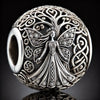
Charms can be especially appealing to someone who already collects keepsakes. The Fairy Tree™ Charm, for example, may appeal to a person who enjoys Irish folklore. Folklore is part of the design inspiration; it should not be confused with proof of a particular historical meaning.
But a charm is not automatically compatible with every bracelet or chain. Check its attachment, dimensions and the recipient's existing jewellery before buying. If compatibility is uncertain, a standalone pendant is often simpler.
Still thinking about a ring? Check the size before you buy
If a ring feels like the right gift, there is no need to abandon the idea. The important part is to avoid choosing a size by appearance alone.
Start with our published guide to measuring ring size at home for an introduction to common methods. For the most dependable fit, ask a qualified jeweller to measure the intended finger with a ring sizer, or take in an existing ring that fits that same finger.
If you have a well-fitting ring to compare, its inside diameter is the relevant measurement—not the outside edge of the band. Use the same finger and hand when possible; ring sizes can vary from finger to finger. String and paper-strip methods can be imprecise, so treat them as rough estimates rather than a guarantee of fit.
How to estimate ring size with everyday household tools
You do not need specialist equipment to make an initial estimate. Start with an ordinary ruler marked in millimetres, a pencil and either a ring that already fits or a narrow strip of paper.
These home methods are helpful checks, but they are not as reliable as a professional ring sizer. In particular, string can stretch and paper can shift, so do not treat a home estimate as a guaranteed fit.
Method 1: An existing ring and a ruler
-
Choose a ring that already fits the same finger on the same hand where the new ring will be worn.
-
Lay it flat on a table. Hold a ruler across the widest part of the empty centre, measuring straight from one inside edge of the band to the other.
-
Record the inside diameter in millimetres (mm), not the outside width of the ring. Compare it with the US size chart below.
-
If the measurement is hard to read, trace the ring's inner edge with a sharp pencil on paper and take the tracing and ring to a jeweller for confirmation.
This is often the easiest household method for a surprise gift, provided the borrowed ring genuinely fits the intended finger. A ring worn on another finger is not a dependable comparison.
Method 2: Paper strip, pen and ruler
-
Cut a thin, straight strip from ordinary paper. Use a narrow strip that does not bunch up.
-
Wrap it snugly but not tightly around the base of the intended finger. Check that the resulting loop could also pass over the knuckle.
-
Mark the point where the paper overlaps with a pen, unfold it and measure from the starting end to the mark using a millimetre ruler.
-
That number is the finger's approximate circumference—it is not the US ring-size number. Divide the circumference by 3.14 to estimate the inside diameter, then compare it with the chart below.
For example, a measured circumference of roughly 54.4 mm gives a diameter of about 17.3 mm, close to US size 7. Treat that as a starting estimate, not a confirmed size.
Method 3: Non-stretch string and a ruler
If you have no suitable paper, use a short piece of non-stretch string and a pen.
Wrap the string around the finger, mark where it meets, straighten it without pulling, and measure the length in millimetres. This also estimates circumference; divide by 3.14 to compare with the diameter column below.
Important: This is a rough fallback only. GIA warns that string and paper can give inaccurate readings. Repeat the measurement and confirm it with a proper ring sizer before committing to a hard-to-resize or special-occasion ring.
Method 4: Printed chart and an existing ring
If you have access to a printer, a reputable printable ring-size chart can help you compare an existing ring with circles of known inside diameter.
Always print at 100% or actual size—not “fit to page”—and verify the chart's printed scale using a ruler.
You can also take the existing ring to a jeweller, who can measure it more precisely.
Small checks that make a difference
-
Measure the correct finger and hand, since the corresponding fingers may be different sizes.
-
Check at a comfortable room temperature, not immediately after extreme cold, heat or strenuous activity.
-
Repeat a home measurement several times and compare the results rather than relying on a single reading.
-
Remember that the knuckle and band width affect comfort; a ring must be able to pass over the knuckle without sliding off too easily.
-
When the measurements disagree or fall between sizes, seek guidance from a jeweller rather than guessing.
For more background, see our home ring-sizing guide, along with GIA's guidance on the limitations of string and paper measurements.
Quick US ring-size reference
The following examples are approximate inside diameters from the Gemological Institute of America's published ring-size chart:
| US ring size | Inside diameter (mm) | Inside diameter (inches, approx.) |
|---|---|---|
| 5 | 15.7 mm | 0.618 in |
| 6 | 16.5 mm | 0.650 in |
| 7 | 17.3 mm | 0.681 in |
| 8 | 18.1 mm | 0.713 in |
| 9 | 19.0 mm | 0.748 in |
These measurements are references, not a substitute for a fitting. A ring must pass comfortably over the knuckle, and band width, temperature and time of day can affect how it feels.
Different countries also use different sizing systems. For a full chart and professional guidance, consult GIA's ring-size guide.
For example, if you are considering the Celtic Knot™ Ring, check the available US size options on the exact product listing before ordering. Do not assume every style is resizable or every size is available.
What about an adjustable ring?
An adjustable band may reduce some sizing uncertainty, but it is not guaranteed to fit everyone.
Only consider that option when the actual product listing confirms an adjustable construction and its intended sizing range. Never force or bend a non-adjustable ring to make it fit.
Make the gift personal with a few words
Whether you choose a necklace, earrings, charm or correctly sized ring, the gift's meaning can begin with a note that sounds like you.
“I thought of our family when I saw this design.”
Or: “This reminded me of the way you always make people feel welcome.”
Those are personal messages, not claims about ancient symbolism. A genuine connection is enough.
Frequently asked questions
What jewellery can I gift without knowing ring size?
Pendants and earrings do not require a finger measurement, though chain length, fastenings and personal preferences still matter. A charm can work if you can confirm that its attachment fits the jewellery she already owns.
How can I find someone's ring size without spoiling the surprise?
If appropriate, ask someone close to her whether they know the size, or have a jeweller measure a ring she already wears on the intended finger. Guessing from appearance is not reliable.
Can I rely on a ring-size chart alone?
A chart helps you compare measurements, but it does not account for everything that affects fit. A professional fitting is the safer choice when sizing matters.
A thoughtful choice without the guesswork
When you do not know the recipient's ring size, focus on what you do know: her habits, her favourite pieces and the story you hope to share.
A pendant, earrings or a compatible charm may be exactly right. And when only a ring will do, taking time to check the fit is part of choosing well.
The gift is not made meaningful by knowing every measurement. It is made meaningful by knowing the person.
-
Posted in
Celtic earrings, Celtic pendants, jewellery gifts without ring size, meaningful gift ideas